
Hello, I’m Pippin, and I’m a guinea pig. Today I’m going to talk about Wounds and Weight.
We’re helping out our Mummy, Jemima Pett, who is doing the A2Z this year by putting together all the posts we’ve done here on George’s Guinea Pig World, to make a book on Guinea Pig Care from A to Z. You can see her posts here: jemimapett.com/blog/. We’re filling in the gaps this month.

Wounds
Generally speaking there are two types of wounds, surface scratches and cuts, and deep puncture wounds. It’s unusual for a guinea pigs to pick up any wounds in their everyday life, unless you have carelessly left something sharp about. Mummy can’t think of any time anyone has cut themselves by accident.
Fights are another matter.
We fight with our teeth, not our toenails, so there again, it’s the teeth that do the damage. Nips are not generally a problem as they don’t break the skin. It’s rarely a scrape, but a bite. And however shallow it is, it’s a puncture wound. And if you aren’t with us when we fight, you may not notice a problem until we’ve already got an abscess filled with nasty pus.
If you don’t know how deep it is and it’s fresh, it’s worthwhile packing the hole(s) with honey cream, cleaning daily, or even twice a day, with cool boiled salt water. If it’s already smelly or exuding a yellow pus, take your pig to the vet. It’s an abscess, it’s likely to have a nasty infection brewing which needs antibiotics. It may also need cream, and daily washing. Your vet will advise.

If you find one lump or hole that looks like a bite wound, check all over for others (and check the pigs that might have been involved). Roscoe had a fight with Bertie about six months after he first arrived, although he had settled in and been socialised, Bertie just got out of hand one day. Mummy found the bite on Roscoe’s neck and took him to the vet for a check. He looked a right mess for days, from washing and then packing with honey-cream. And then she found a hole underneath his neck, from Bertie’s bottom teeth! He’d really given Roscoe a go!
Poor Roscoe was a very gentle soul, but he could stand up for himself. Bertie always seemed as good as gold (but was a total mischief). This was totally unexpected to everyone. But they got over it and even got to be good chums, exploring the new house together when they moved down here.

Haypoke
This is horrible and very ouchie. I know because I’ve had it. Sometimes (only twice in Mummy’s experience) a pig will be foraging in his hay and bit goes in his eye. When I had it the hay stayed in and I had my head on one side, feeling poorly when Mummy came in. She took it out, and took me to the vet. Dr Rebekah put some drops in it and looked at it with a funny coloured light. It showed up the damage to the covering of my eye, but nothing worse than that. I had to have eye drops for several days. It stopped being sore and got better very quickly.
Weight
The easiest way to keep an eye on our health is to weigh us regularly. Once a week is ideal. It catches the start of weight loss while something can be done about it. Monthly is okay when your pigs are well, but if they start to look at all peaky, weigh them more often. If they are actually ill, weigh daily.
Although we always look a bit tubby, it’s an illusion. Most of us don’t actually carry a lot of fat, its the hay we’re digesting in our bellies that makes us look so rotund. As we get older, it’s natural for the skin on our necks to droop a little, as you can see from Roscoe’s photo above.
Normal weight for adult boars is considered to be 900 to 1200 grams. Mummy thinks that’s for normal pigs. In her experience Norfolk pigs are, for some reason, much bigger. They generally weigh 1100-1500 grams. Over that, yes, they might be a tad overweight. But many of her pigs have been around 1450 in their prime. But the Jersey pigs, Colman and Kevin, were definitely smaller. They fit into the expected range, and so do the Hampshire pigs, Ronnie and Reggie. And although Ludo, Locksley, Victor the Red and I all lived most of our lives in Hampshire, we started life in Norfolk (or Suffolk). We have Norfolk genes. Roscoe and Neville were from Tyneside. They were on the heavy side, too.
Sows are lighter, in the main.
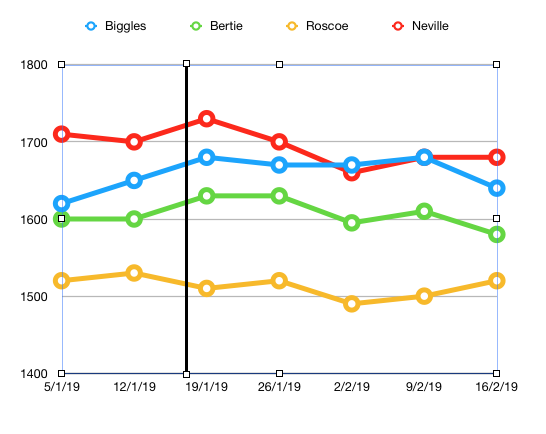
The main thing is that we should be a steady weight, and not go up and down a lot. Mummy has made graphs of our weight in the past which show trends easily. She doesn’t think that graph looks right, she doesn’t remember anyone being over 1600, not for long, anyway. She thinks the black vertical line was when she bought new weighing scales, like the ones we have now.
These days she just looks back on her notes and notices that I’ve been losing weight steadily over the last year. She’s not too worried, because she’s noticed that as boars get older, they tend to drop a level in weight, from 1300 to 1200 or similar, and then stay there for a good long while. So she doesn’t worry too much, unless they keep losing.
But when a pig is ill they can lose a lot of weight very quickly. And the first thing you may notice is the weight loss. You need to act fast, as it probably means something’s been wrong for a while. We tend to hide it when we’re ill, so weight is one of the easiest things to check that we can’t hide from you.
I can’t think of anything else to do with weight, except to avoid giving us baked snacks and treats, because they may have sugar or oil in them. We have treats from the Naturals range, or Norah’s salads, or Excel biscuits. Nothing to make us fat, anyway.
Thats it for W, I hope you found it helpful. Tomorrow is X, and it’ll be fascinating, I promise.
Love
Pippin xxx

