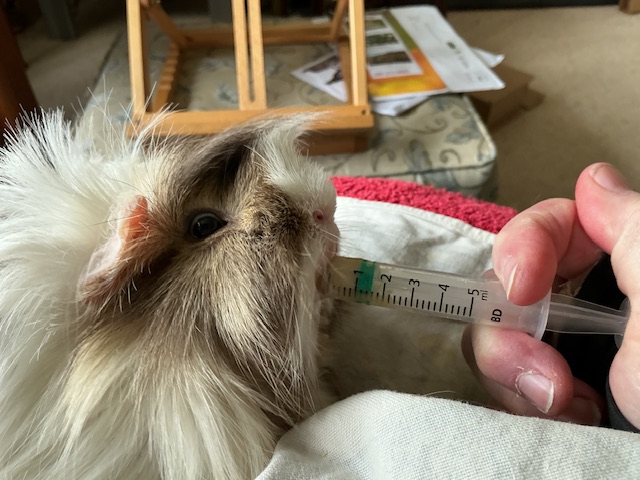
Hello, I’m Pippin, and I’m a guinea pig. Today I’m going to talk about you and your guinea pigs, and something you will almost certainly need to do at some stage. It’s got a Y in it, so I’m making it fit in here!
We’re helping out our Mummy, Jemima Pett, who is doing the A2Z this year by putting together all the posts we’ve done here on George’s Guinea Pig World, to make a book on Guinea Pig Care from A to Z. You can see her posts here: jemimapett.com/blog/. We’re filling in the gaps this month.

You and your guinea pigs
All of your guinea pig’s needs are provided by you. It’s part of them being your companion animal. And if you don’t want a companion, then why did you get them? Although as you are reading this, you probably do want a companion animals, and you want to do your best by them. We are just as sensitive to your needs, although we might not show it much. Opportunities are limited. But we know if you’re happy, or sad, or stressed, and we’re very good at taking your mind off things. Stroking us can even help your health by bringing your blood pressure down. Sitting us quietly and communing with us can do wonders for your health. Don’t take my word for it, ask Uncle Bob.
You also need to take care of our health, though, as we are dependent on you. So today I’m going to talk about something you’ll have to do sometime, almost certainly – syringe feeding.
Syringe Feeding
You need to give us medicine or liquid feed, then the best way is to administer it by tube, or syringe. This led to Fred and George and the gang calling meds ‘tubejuice’.
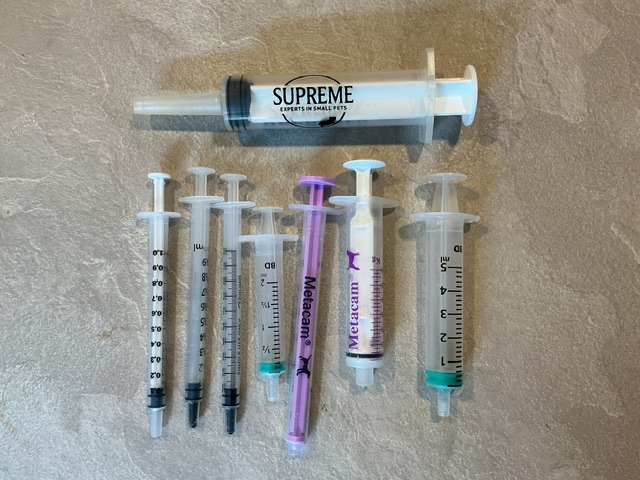
Syringes come in different sizes, but on the whole, use the smallest you can because we have small mouths, and it’s easier for your and us to use the thinner tubes. The bigger ones do have small mouthpieces but they are easy for us to bite off, as I know. Mummy tried to fish a piece out of my mouth one day but as soon as I realised I spat it out – well mangled!
Our mouths are not very big, and we find it difficult to cope with more than 0.5ml of liquid at a time. Sometimes we do work out how to drink and swallow, but we can’t cough things up, and you don’t want us to breath whatever it is you’re giving us, so take it slow.
Also, if you fill a syringe with water and squirt it in the sink, you’ll see it comes out very fast. It’s best not to press hard to make it squirt into our mouths, as there’s a good chance it’ll go down the wrong way. And we can’t cough things up again, although you’ll think we’re trying.
So, the best way to think about syringing food or meds into our mouths is: slow, no more than 0.5ml at a time, and angle it to the side of our mouths, not the back. Once we’ve got the hang of it, we’ll probably try to help you do it how we like it.
Then again, some pigs never get the hang of it and do their best to stop you giving them whatever you’re trying to do, however sick or hungry they are.
Syringing meds
Some meds taste okay, some are horrible. There is nothing to stop you tasting it yourself to check, just a smear of it would be sufficient, and it wouldn’t hurt you. (Except perhaps Thyroxine. Don’t taste Thyroxine if you have to give it to a pig with thyroid trouble). The worst tasting is probably Baytril. The best thing to do with Baytril is to put a small amount of fruit juice (not sugared) in a small glass, draw up the correct dose of Baytril into the syringe, then put the tip into the juice and draw up the juice so both are in the tube together. Tap the tube gently to mix it a bit, like you see the doctors do on tv. It’s still tastes bad, but not absolutely awful.
Don’t mix meds in the same syringe, and if possible use a different syringe for each med. Mummy puts a marker on the plunger top of each of them if she’s using similar syringes. Although they say ‘use once and discard after use’ on them, you can keep them for lots of weeks if you need to. Replace them when we get the ends a bit chewed and roughened.
If you are doing antibiotics, mix up a small amount of Pro-biotic like Bio-Lapis in an egg-cup or very small jar. If you keep it cool it’ll do a couple of days. You should give the probiotic in the session when you’re doing the antitbiotic, but any time that day will do.
Syringing food
Most of the emergency food (recovery food) is disgusting and difficult to syringe. You have to mix the stuff up from a packet and it won’t feed through a normal syringe, you’ll have to get a special enormous one. The mouth is as big as our mouths, and consequently most of what you syringe will go down our cheeks, chins, chest and all over you.
A better solution for sick piggies in need of nourishment is Emeraid IC. It’s meant for intensive care patients, but if you can afford it, it is a much better, and more tasty solution to getting liquid food into us. I’m not totally convinced, but Victor, Colman, Kevin, Percy, Roscoe, Neville and even Ronnie agreed that (a) it’s yummy and (b) it fills them up. You still have to persuade me to eat it, but they used to take one look at the syringe and head to it to lock on.

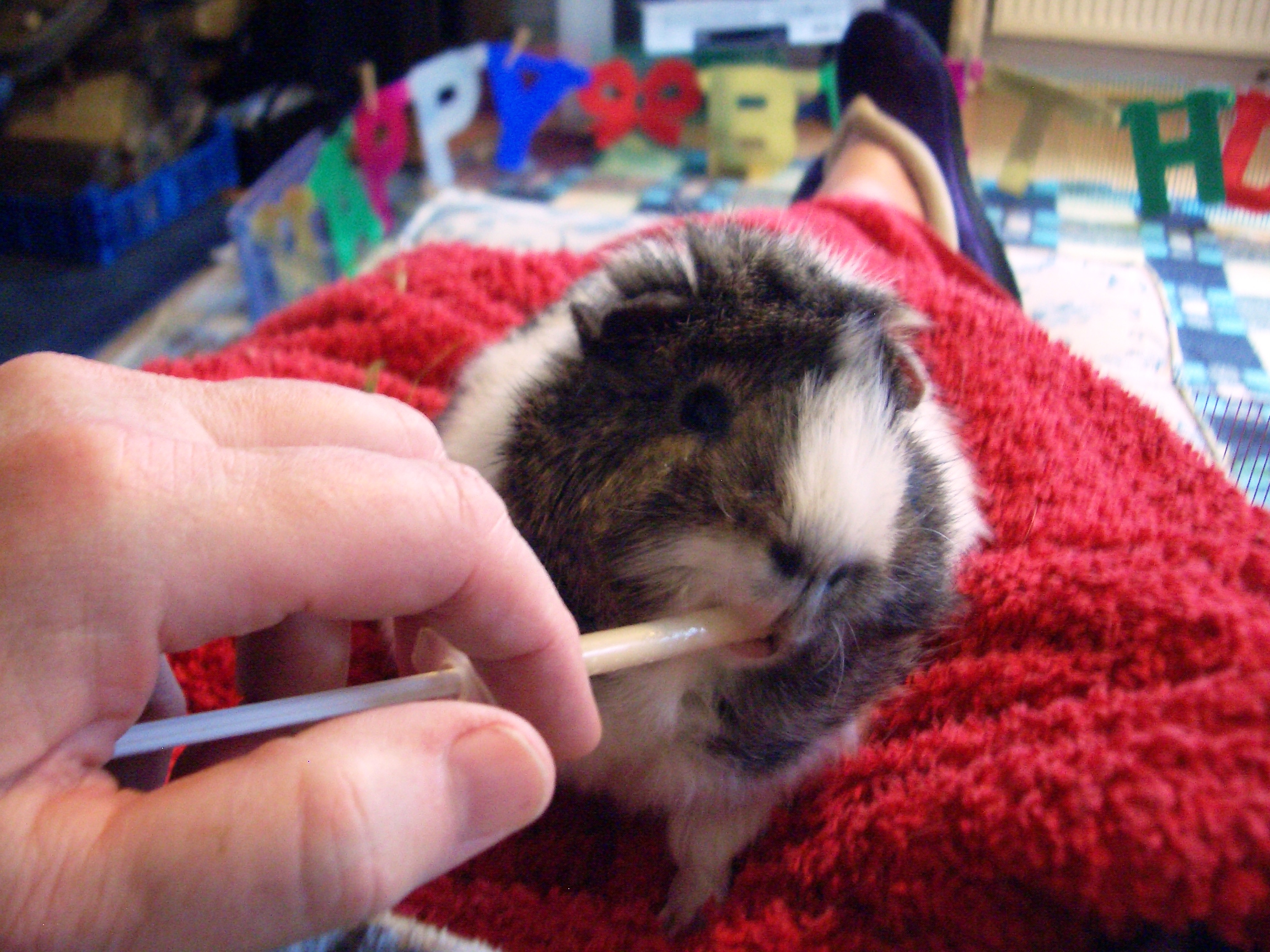
You may wonder at them sitting happily on Mummy’s lap with no constraint. When Mummy gives me my nasty tasting meds she leans over me, squeezing me alongside her body, and holding my head with her far hand while she persuades me to take the syringe she’s holding in the other. She’s very patient. She says she’s used to impatient patients! George used to turn his head from side to side until he gave up and held it still. I tend to wrinkle the far side of my lip when I’m ready, and Mummy has to slip in then!
Some people wrap their pigs in a towel to stop them squirming. Then hold them in the crook of their arm like a baby. Mummy prefers to keep us the normal way up, just to reduce the risk of us choking. George did directions for ‘how to wrap a pig’. I wonder if I can find it? Oh, Mummy’s added it below.
That’s it for today. Tomorrow is The End. But I have a wonderful word for you tomorrow!
love
Pippin xxx
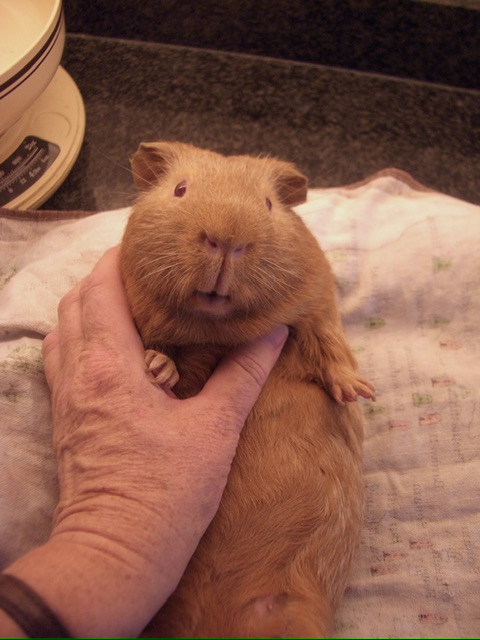
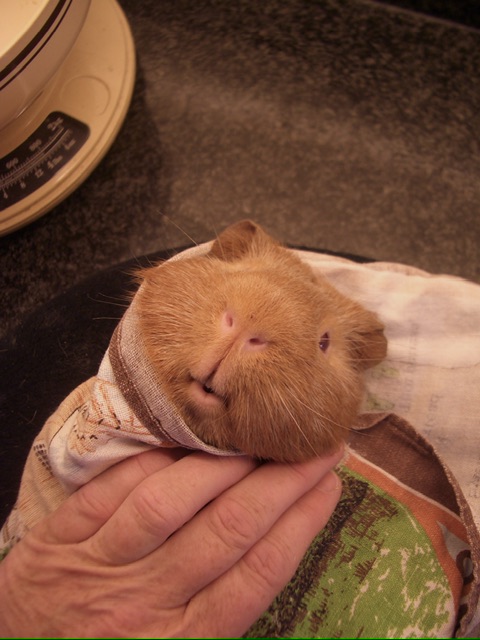
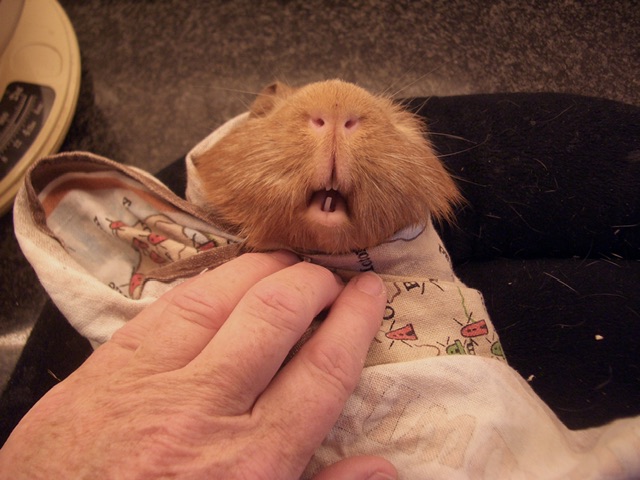
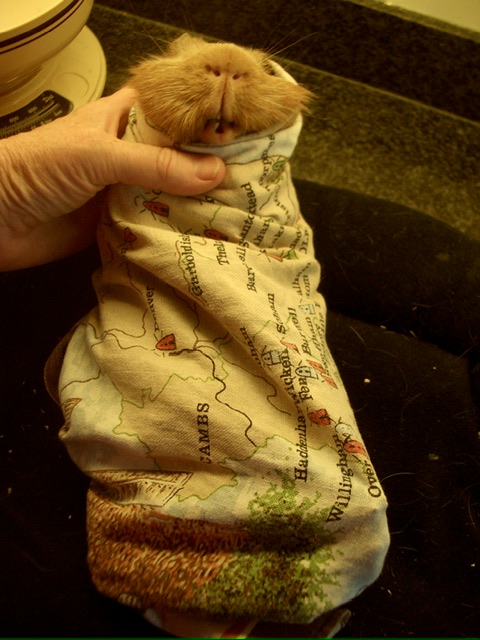
1) lay your pig on a tea towel or similar, in the middle of the long side, head at the top of the towel. 2) take one side across and tuck it tightly under your pig’s neck. 3) take the other side across and tuck it tightly under under his neck and around his back. If these two bits aren’t tight he will wriggle out. Starting with freeing one of his feet, usually. 4) fold the rest of the towel underneath so he’s all wrapped up and feels safe. And no, not all pigs are as obliging as George!

