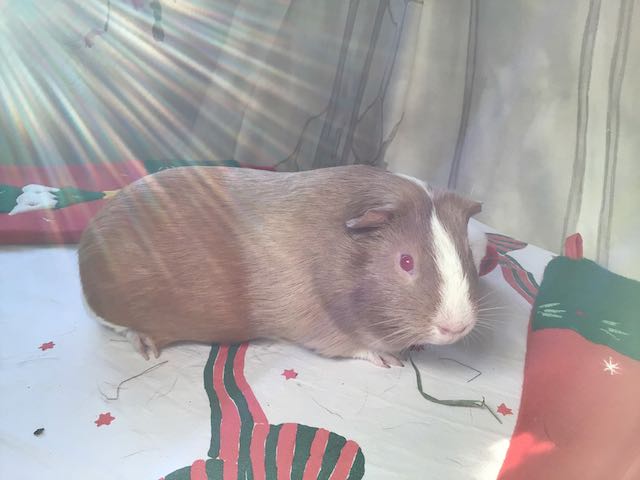
Hello, I’m Pippin, and I’m a guinea pig. Today I’m going to talk about Toenails, and how to trim them, and Tribes.
We’re helping out our Mummy, Jemima Pett, who is doing the A2Z this year by putting together all the posts we’ve done here on George’s Guinea Pig World, to make a book on Guinea Pig Care from A to Z. You can see her posts here: jemimapett.com/blog/. We’re filling in the gaps this month.

Toenails
At the end of our feet we have toes, four on each front foot, three on each back foot. And each toe has a toenail, which like our teeth, grow constantly. We generally manage to keep our teeth ground down by eating hard things, like we are designed to, like hay and pellets. But we don’t do anything much to wear our toenails down, not like we would in the wild.
So we get to every guinea pig’s, and every guinea pig carer’s nightmare….
Toenail trimming
This is me in December 22, when I was less than one year old. It’s one of the few photos showing both back and front feet. The back toes are slightly long, but okay; front are okay. Up till about six months toenails don’t really need doing, although sharp points can be filed off, if you can keep the youngster still long enough.
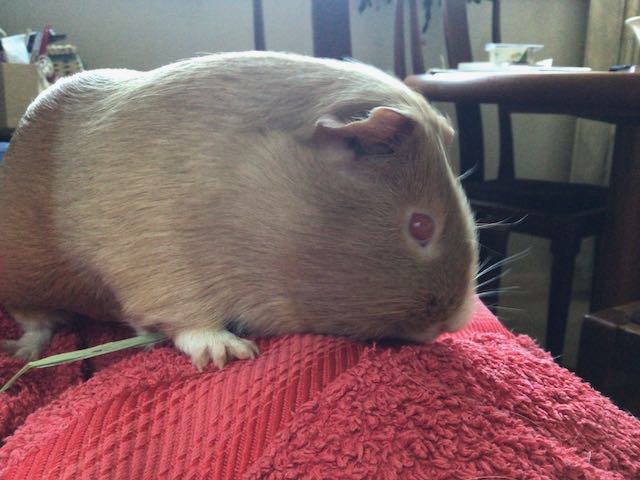
Here I am on my first birthday, January 23, and my nails are the right length. It’s probably the only picture Mummy could find with them just right.
Toenails come in all shades of brown, from white/cream to black. Pigs can be dark coloured with light toenails. Colman was lemon agouti but his toenails were very dark brown. Percy was black, and so were his nails. Ludo and Hugo were black and white, and both had three white feet and one black one, with nails the same colour. My nails are pale, Victor’s were darker.
The toenail is alive up to roughly halfway along. There’s a little blood vessel that goes through them called ‘the quick’. The blood vessel keep the nail alive, and after the blood vessel finishes, the nail is effectively dead. That’s where it can be cut.
And everybody gets nervous about the nail clippers clipping the quick. Ouchies. Mummy gets nervous, I get nervous, everybody gets nervous. Even vets.
And because we’re nervous just as you get to the stage where you’re going to cut – we pull our foot away, just in case. And you miss. And we have to start again, you lining the clippers up in the very small space around our nails, moving it up and down to get to just the right place – and just in case you’re too high, we move again. And you’re holding us tight and telling us not to move, and we’re worried you’re gong to miss and cut the quick, and… you don’t. And the first one is successfully trimmed. Now for the other thirteen…
Where to cut
Mummy’s made some pictures… of my front foot and Ludo’s back one.
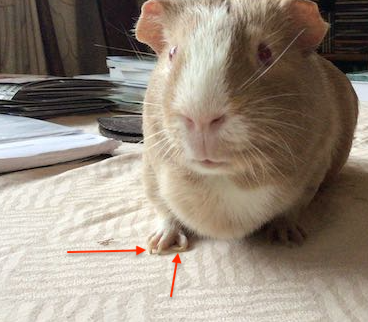
Ooo-er. The arrow points to just about where my nail is looking worn and dirtier, basically just after the curve. The one on the inside is curlier, and this is a problem everybody has. The inside and outside nails tend to curl because they aren’t cut soon enough when we are younger, so they learn to grow around and under the foot. Ludo’s arrows are pointing to where his nails are whiter: the nail there is dead. His probably don’t really need doing just yet. Mine do, although it’ll probably be left a few more days.
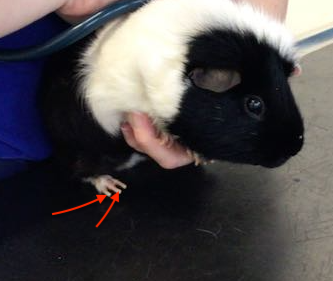
What if the nails are dark? Hopefully you have pigs with different colour nails (or a Ludo/Hugo with different coloured feet). Use that as your guide and trim to the same length as the lighter toes. If you do all the pigs at the same time, they will probably be much the same length when they next need doing.
The other guideline is: do them little and often. If you get them the right length, then trim them by the width of the scissors or clipper blade each week or two, you should be fine, and so will we. I expect if you do that and you don’t catch the quick, we’ll stop worrying so much.
Cut to the quick
If you do cut the quick so it bleeds, don’t panic. We’ll squeak, but we won’t panic any more than we were. You can use a cotton wool pad or similar to hold over it till it stops, or dab it in a little cornflour, or there’s something called a styptic pencil you can use if you have one. Mummy holds the cotton wool pad on it, and if necessary tries the cornflour method.
If you have someone to hold the pig while you cut the nails it will be much easier. Mummy does them on her own. There are two methods. One, hold us so we are sitting with our backs to her, and she can hold our feet easily. If we don’t wriggle. Second, have us sit somewhere secure, lean over us to do one side, then turn us round, and lean over us again to do the other. One way is always going to be more difficult depending on which hand you use for clippers.
And of course, give us a treat when you’re done. And you can have a treat too.
Tribes
Although most boars live in pairs, it is possible to have non-paired boars running around on the floor or other large space like an enclosed run on the grass. The trick is to make introductions slowly.
Mummy uses some of her run panels to make a very small floor run for newcomers, so they can say hello to everyone and watch what happens. Once the nosing and everything has gone on for enough days (or weeks) that people aren’t getting too excited, you can let them run about together. But initially, at least, stay with the new members of the tribe and make sure everything is working okay. Don’t leave them alone during the first few days. And when you do, listen out for any problem noises.
Some pigs never get into this. They always argue, always want to be bossy. The others don’t accept them. Sometimes you have to know who gets on with who so you get the right combination on the floor at the same time.
Examples:
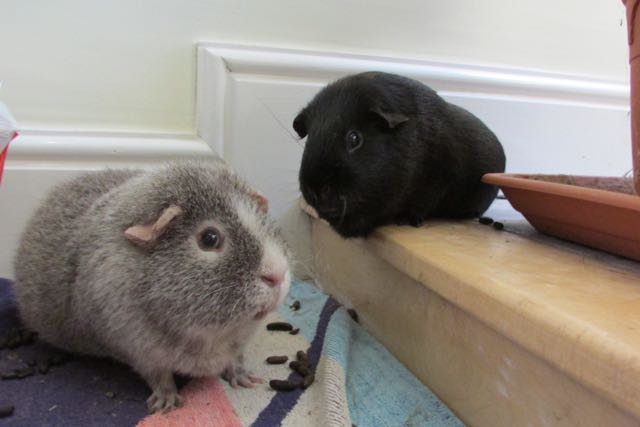
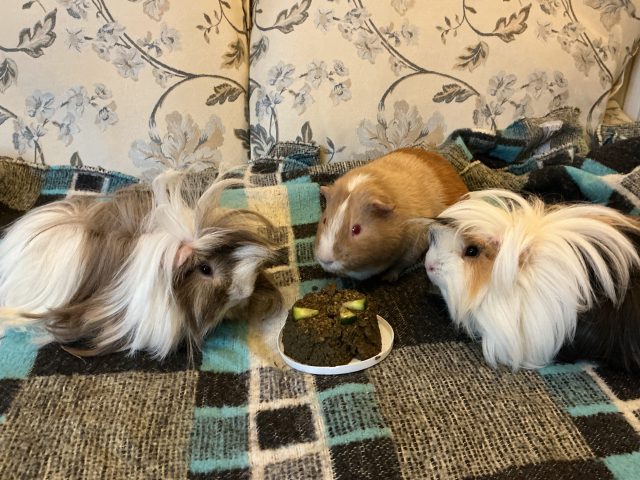
- Right now I get on fine with Reggie, but Ronnie and I haven’t quite got there, so I have my floor time first, then Reggie joins me, then Ronnie comes to join him and I go back to my cage. It has progressed from I go back to my cage then Ronnie comes in, though. One day we may all get on together.
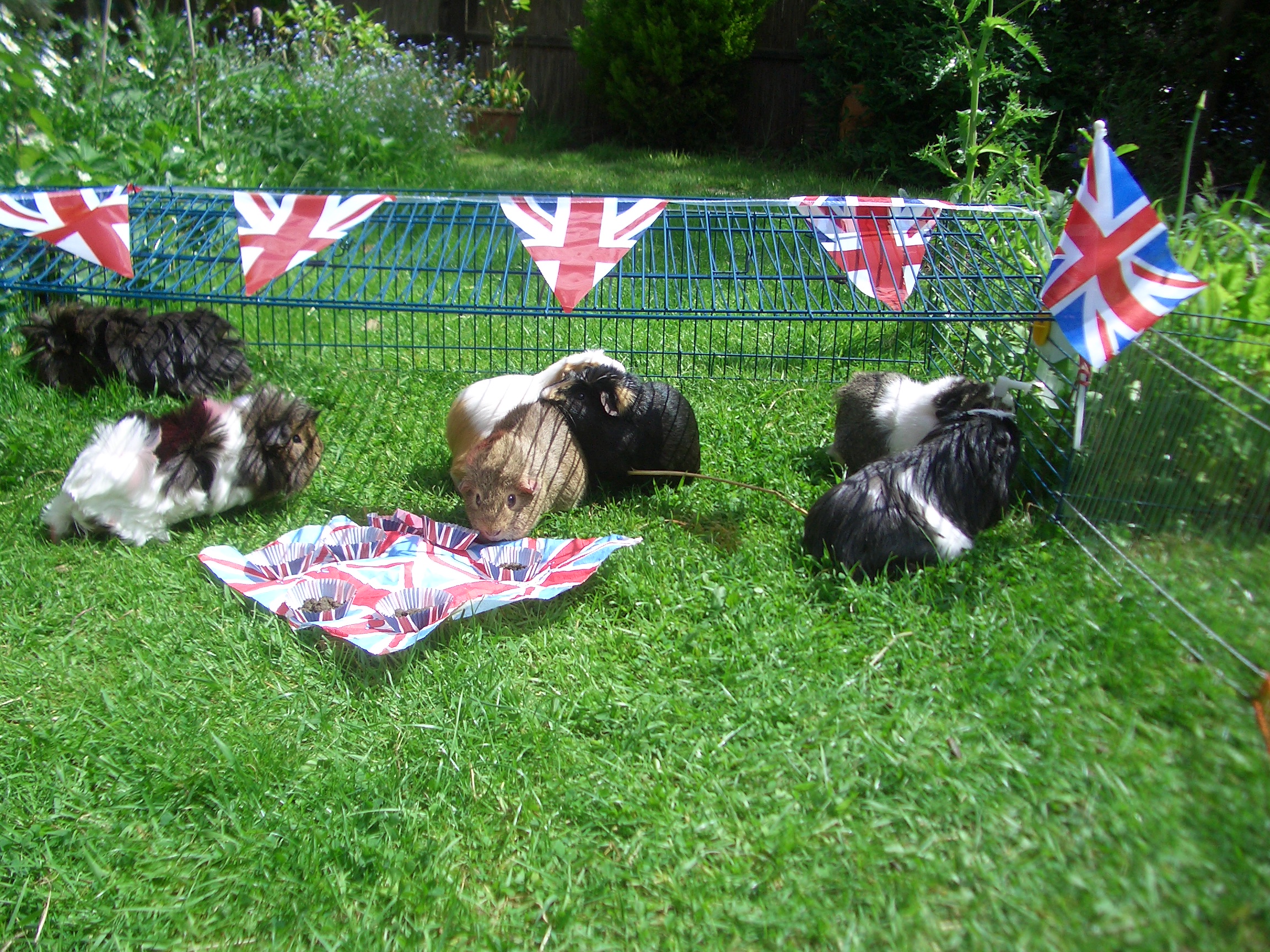
- When Mummy had lots of pigs, Humphrey got on with everyone, but Hector fell out with everyone; Dylan and Dougall got on with everyone else, but Dylan was in charge; Victor the First got on with everyone; and Kevin and Colman got on with each other, but not so much everybody else, although Kevin got on with most of them. That was the Jubilee Seven Tribe. The picture of their Jubilee tea party was the only time they were all out together.
- The next tribe was with Oscar and Midge (brothers who fell out); Percy, who arrived on his own and got on with everyone, Bertie and Biggles (who fell out after about a year, but lived with Percy when they came as babies), and eventually Roscoe and Neville. Bertie didn’t like Roscoe at first, but then Bertie always thought he was important, and he wasn’t. Oscar could be a bit funny, so he was generally first out and went back when Midge came down.
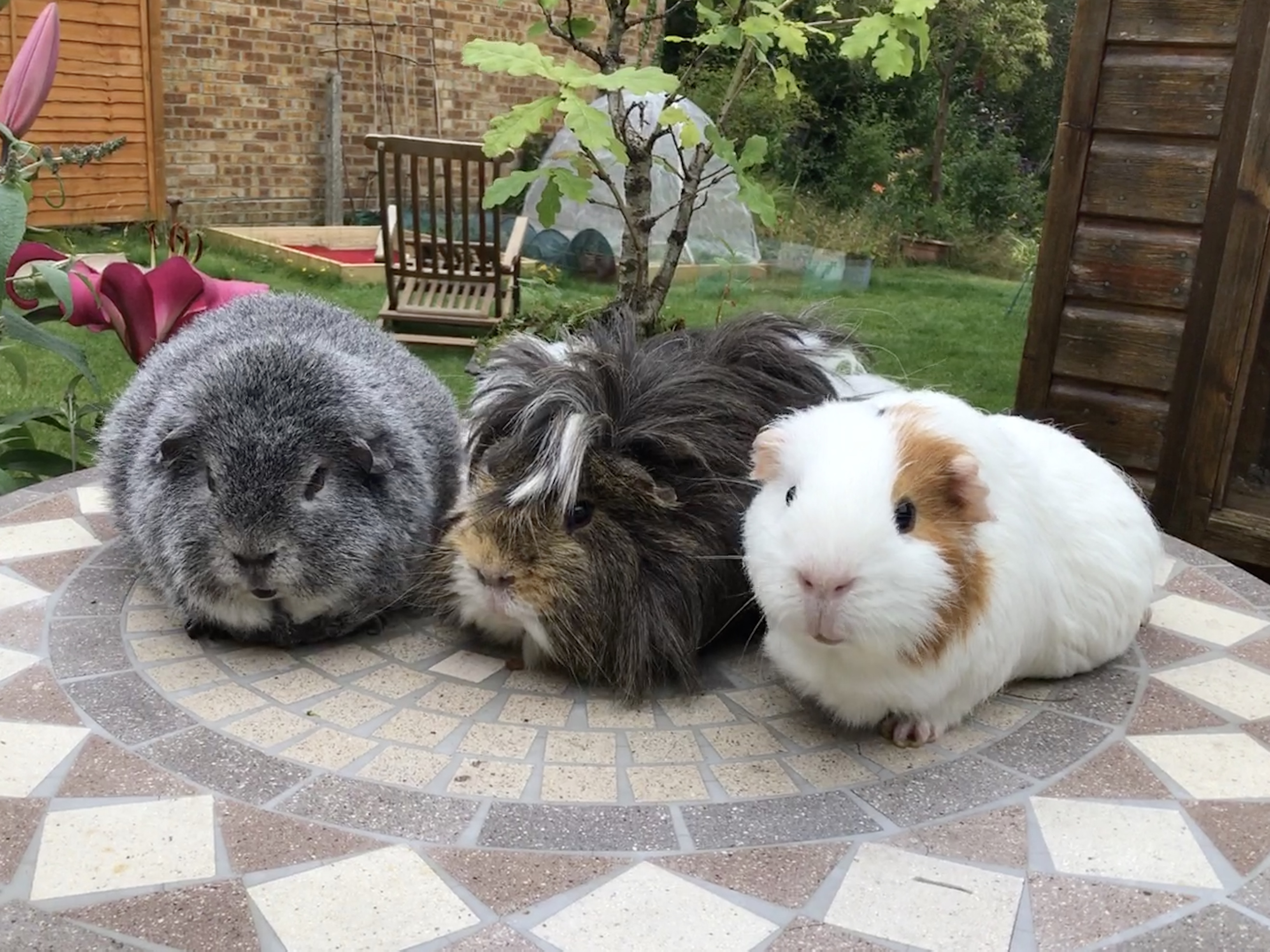
- Bertie and Biggles, Roscoe and Neville were the first Hampshire pigs. Bertie died suddenly, so the three got on very well together, and welcomed Ludo and Locksley in time. Ludo had some personality problems, and didn’t get on with anyone, including Locksley once Locksley got a little older. Locksley just got very confused because Ludo would tell him off for doing things like taking treats from Mummy. And Locksley thought Biggles must be his daddy or brother or something, because they looked so alike. Biggles wasn’t well enough to be patient with a baby, so that didn’t go so well. But nobody got into any fights, because Ludo always wanted to be on his own, so he went in while the rest had fun.
- Victor and I arrived after Biggles died, and Locksley and Ludo were living in separate cages. Then I fell out with Victor and we all had separate cages. But at grass time Victor and Locksley got on well enough, and Ludo used to laugh at my fun and games in the covered run. So even though we didnt live together, we were still a tribe.


That’s it for today. I hope you found T useful. Come back for U tomorrow.
love
Pippin xxx


My goodness, what tribal interactions! Cutting your nails is like having my claws cut, says Garfield. I have to corral him to do it. The same with Samantha. Neither of them like it at all. And I also have to be careful not to cut too far along the claw, or it bleeds! I’m nervous when I do it.
LikeLiked by 1 person
I’m still working my way through the posts I’ve missed.
The late, great Mariusz was so unruly during toenail trimming that we’d have to put a sock over his head so he couldn’t see what we were doing. This is an unorthodox approach, and I don’t recommend it, and I’m sure your mummy wouldn’t either. But Mariusz was Mariusz.
He’d wriggle out of the sock anyway. Sigh …
XXXOOO
LikeLike